
|
FreeComputerBooks.com
Links to Free Computer, Mathematics, Technical eBooks all over the World
|
|
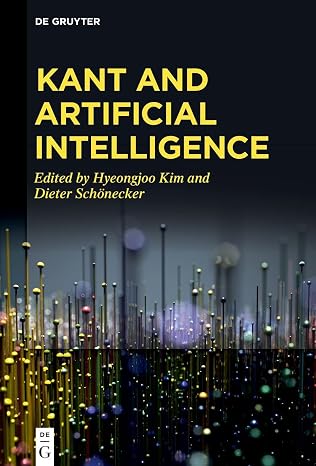
- Title: Kant and Artificial Intelligence
- Author(s) Hyeongjoo Kim, Dieter Schönecker
- Publisher: De Gruyter; 1st edition (2023); eBook (Creative Commons Licensed)
- License(s): Creative Commons License (CC)
- Hardcover: 297 pages
- eBook: PDF and ePub
- Language: English
- ISBN-10: 3111355691
- ISBN-13: 978-3111355696
- Share This:
|
How are artificial intelligence (AI) and the strong claims made by their philosophical representatives to be understood and evaluated from a Kantian perspective? Conversely, what can we learn from AI and its functions about Kantian philosophy’s claims to validity?
About the Authors- Hyeongjoo Kim, Chung-Ang University, Seoul, Republik Korea.
- Artificial Intelligence and Logic Programming
- Machine Learning
- Neural Networks and Deep Learning
- Robotics and Robot Programming
 Similar Books:
-
 Demystifying Artificial Intelligence: Symbolic, Data-Driven, etc.
This book is intended for business professionals that want to understand the fundamental concepts of Artificial Intelligence, their applications and limitations. Demystifying AI through fundamental concepts and industry examples.
-
 AI Demystified (Alex David Pratt)
The book explores the potential of artificial intelligence to transform everyday life while highlighting both the benefits and risks. The book encourages readers to embrace AI responsibly, focusing on its impact on healthcare, creativity, and society.
-
 Unlocking Artificial Intelligence: From Theory to Applications
A state-of-the-art overview of current machine learning research and its exploitation in various application areas. Deep integration of artificial intelligence (AI) methods in products and services is essential for companies to stay competitive.
-
 Mission AI: The New System Technology (Haroon Sheikh, et al.)
This open access book offers a strategic perspective on AI and the process of embedding it in society. After decades of research, Artificial Intelligence (AI) is now entering society at large.
-
 AI - Limits and Prospects of Artificial Intelligence (Peter Klimczak)
This book explores the limits of AI, describe the necessary conditions for its functionality, reveal its attendant technical and social problems, and present some existing and potential solutions.
-
 AI for Everyone? (Pieter Verdegem)
We are entering a new era of technological determinism and solutionism in which governments and business actors are seeking data-driven change, assuming that Artificial Intelligence is now inevitable and ubiquitous.
-
 Making AI Intelligible (Herman Cappelen, et al.)
Can humans and artificial intelligences share concepts and communicate? The questions addressed in the book are not only theoretically interesting, but the answers have pressing practical implications.
-
 What Was Artificial Intelligence? (Sue Curry Jansen)
Prescient autopsy of AI self-selling - the rhetoric of the masculinist sublime - is reprinted with a new introduction. Now an open access book, it's a message in a bottle, addressed to Musk, Bezos, and the latest generation of AI myth-makers.
-
 Artificial Intelligence: Foundations of Computational Agents
This text is a modern and coherent introduction to the field of Artificial Intelligence that uses rational computational agents and logic as unifying threads in this vast field. Many fully worked out examples, expanded coverage on machine learning material, etc.
-
 Robots and AI (Lili Yan Ing, et al)
The book explains new approaches on how robots and artificial intelligence affect the world economy by presenting detailed theoretical framework and country-specific as well as firm-product level-specific exercises.
-
 Artificial Intelligence for Big Data (Anand Deshpande, et al)
You will learn to use machine learning algorithms such as k-means, SVM, RBF, and regression to perform advanced data analysis. You will understand the current status of machine and deep learning techniques to work on genetic and neuro-fuzzy algorithms.
-
 Artificial Intelligence for a Better Future (Bernd Stahl)
This book proposes a novel approach to Artificial Intelligence (AI) ethics. AI offers many advantages: better and faster medical diagnoses, improved business processes and efficiency, and the automation of boring work.




