
|
FreeComputerBooks.com
Links to Free Computer, Mathematics, Technical eBooks all over the World
|
|

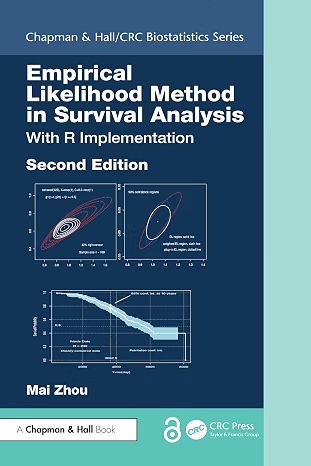
- Title: Empirical Likelihood Method in Survival Analysis: With R Implementation
- Author(s) Mai Zhou
- Publisher: Chapman and Hall/CRC, 2nd Edition (2026); eBook (Creative Commons Licensed)
- License(s): Creative Commons License (CC)
- Hardcover: 372 pages
- eBook: PDF, ePub, and Read Online
- Language: English
- ISBN-10: 1032986352
- ISBN-13: 978-1032986357
- Share This:
|
This book systematically covers Empirical Likelihood methods in most important topics in Survival Analysis: the Kaplan–Meier and the Nelson–Aalen estimator, the log rank test, the Cox proportional hazards model and the accelerated failure time models.
About the Authors- Mai Zhou is a professor emeritus at University of Kentucky. He received his Ph.D. degree in Statistics from Columbia University.
 Similar Books:
-
 Age-Period-Cohort Analysis: Models, Methods, Empirical Apps
Encompassing both methodological expositions and empirical studies, this book explores the ways in which statistical models, methods, and research designs can be used to open new possibilities for Age-Period-Cohort (APC).
-
 Understanding Statistics and Experimental Design
Provide the background needed to correctly use, interpret and understand statistics and statistical data in diverse settings. Readers with little or no background in statistics will appreciate how these fundamental concepts are so well illustrated.
-
 Think Stats, 2nd Edition: Exploratory Data Analysis in Python
This concise introduction shows you how to perform statistical analysis computationally, rather than mathematically, with programs written in Python. You'll become familiar with distributions, the rules of probability, visualization, and many other tools and concepts.
-
 Mostly Harmless Statistics (Rachel L. Webb)
This text is for an introductory level probability and statistics course with an intermediate algebra prerequisite. The focus of the text follows the American Statistical Association's Guidelines for Assessment and Instruction in Statistics Education (GAISE).
-
 Introduction to Modern Statistics (Mine Çetinkaya-Rundel, et al.)
This book puts a heavy emphasis on exploratory data analysis and provides a thorough discussion of simulation-based inference using randomization and bootstrapping, followed by a presentation of the related Central Limit Theorem based approaches.
-
 Foundations in Statistical Reasoning (Pete Kaslik)
This book is designed for students taking an introductory statistics class. The emphasis throughout the entire book is on how to make decisions with only partial evidence. It focuses on the thought process.
-
 Theory of Statistics (James E. Gentle)
This book is directed toward students for whom mathematical statistics is or will become an important part of their lives. It covers classical likelihood, Bayesian, and permutation inference; an introduction to basic asymptotic distribution theory; and modern topics.
-
 O'Reilly® Think Bayes: Bayesian Statistics in Python
If you know how to program, you're ready to tackle Bayesian statistics. With this book, you'll learn how to solve statistical problems with Python code instead of mathematical formulas, using discrete probability distributions rather than continuous mathematics.
-
 Statistical Inference: Algorithms, Evidence, and Data Science
A masterful guide to how the inferential bases of classical statistics can provide a principled disciplinary frame for the data science of the twenty-first century. Every aspiring data scientist should carefully study this book, use it as a reference.
-
 Foundations of Descriptive and Inferential Statistics (H. van Elst)
This book aim to provide an accessible though technically solid introduction to the logic of systematical analyses of statistical data to both undergraduate and postgraduate students, in particular in the Social Sciences, Economics, and the Financial Services.
-
 Statistics Done Wrong: The Woefully Complete Guide (Reinhart)
Scientific progress depends on good research, and good research needs good statistics. But statistical analysis is tricky to get right, even for the best and brightest of us. You'd be surprised how many scientists are doing it wrong.
-
 Lies, Damned Lies: How to Tell the Truth with Statistics
The goal is to help you learn How to Tell the Truth with Statistics and, therefore, how to tell when others are telling the truth ... or are faking their "news". Covers Data Analysis, Binomial and normal models, Sample statistics, confidence intervals, hypothesis tests, etc.




