
|
FreeComputerBooks.com
Links to Free Computer, Mathematics, Technical eBooks all over the World
|
|
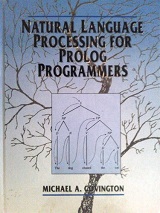
- Title: Natural Language Processing for Prolog Programmers
- Author(s) Michael A. Covington
- Publisher: Prentice Hall (1993); eBook (Covington Innovations, 2013)
- Permission: "You are welcome to make copies of this book, printed or electronic, for your own use"
- Paperback: 348 pages
- eBook: PDF (361 pages, 30.8 MB)
- Language: English
- ISBN-10: 0136292135
- ISBN-13: 978-0136292135
- Share This:
|
Designed to bridge the gap for those who know Prolog but have little or no background in linguistics, this book concentrates on turning theories into practical techniques. Coverage includes template and keyword systems, definite clause grammars (DCGs), English syntax, unification-based grammar, parsing algorithms, semantics, and morphology. Helpful appendices present an in-depth review of Prolog and ready-to-use string input and tokenization routines
An examination of natural language processing in Prolog for those who know Prolog but not linguistics, this book enables students to move quickly into writing and working in useful software. It features many working computer programs that implement subsystems of a natural language processor.
These programs are designed to be understood in isolation from one another and are compatible with an Edinburgh-compatible Prolog implementation, such as Quintus, ESL, Arity and ALS.
About the Authors- Michael A. Covington is Senior Research Scientist Emeritus and former Adjunct Professor of Computer Scienceone at Institute for Artificial Intelligence, The University of Georgia.
 Similar Books:
-
 Prolog and Natural-Language Analysis (Fernando Pereira, et al)
A concise and practical introduction to logic programming and the language Prolog both as vehicles for understanding elementary computational linguistics and as tools for implementing the basic components of natural-language-processing (NLP) systems.
-
 Natural Language Processing Techniques in Prolog
This book introduces the subject through the discussion and development of various computer programs which illustrate some of the basic concepts and techniques of natural language processing (NLP).
-
 Foundations of Large Language Models (Tong Xiao, et al.)
This is a book about Large Language Models (LLM). It primarily focuses on foundational concepts rather than comprehensive coverage of all cutting-edge technologies: pre-training, generative models, prompting techniques, and alignment methods.
-
 Large Language Models in Cybersecurity: Threats and Mitigation
This open access book provides cybersecurity practitioners with the knowledge needed to understand the risks of the increased availability of powerful Large Language Models (LLM) and how they can be mitigated.
-
 Understanding Large Language Models (Jenny Kunz)
This practical book offers clear, example-rich explanations of how Large Language Models (LLM) work, how you can interact with them, and how to integrate LLMs into your own applications.
-
 Foundation Models for Natural Language Processing
This open access book provides a comprehensive overview of the state of the art in research and applications of Foundation Models and is intended for readers familiar with basic Natural Language Processing (NLP) concepts.
-
 Speech and Language Processing (Dan Jurafsky, et al)
This text takes an empirical approach to the subject, based on applying statistical and other machine-learning algorithms to large corporations. It describes a unified vision of speech and language processing. Emphasis is on practical and scientific applications.




