
|
FreeComputerBooks.com
Links to Free Computer, Mathematics, Technical eBooks all over the World
|
|
- Title: Understanding Conversational AI: Philosophy, Ethics, and Social Impact of Large Language Models
- Author(s) Thierry Poibeau
- Publisher: Ubiquity Press (2026); eBook (Creative Commons Licensed)
- License(s): Creative Commons License (CC)
- Hardcover/Paperback: N/A
- eBook: PDF and Read Online
- Language: English
- ISBN-10/ASIN: B0H9ZJ88J4
- ISBN-13: N/A
- Share This:
|
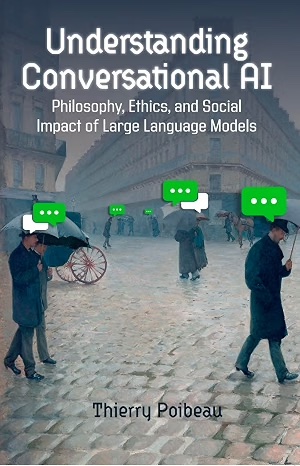
What do large language models really know-and what does it mean to live alongside them? This book offers a critical and interdisciplinary exploration of large language models (LLMs), examining how they reshape our understanding of language, cognition, and society.
About the Authors- Thierry Poibeau is a Director of Research at CNRS and an Affiliated Lecturer at the Department of Theoretical and Applied Linguistics (DTAL) of the University of Cambridge.
- Artificial Intelligence (AI)
- Machine Learning
- Neural Networks and Deep Learning
- Robotics and Robot Programming
 Similar Books:
-
 Artificial Intelligence, Data and Robotics (Edward Curry, et al.)
This open access book explores the rapidly evolving landscape of artificial intelligence, data and robotics (ADR), highlighting their foundational principles, transformative applications and future directions.
-
 AI Fairness: Designing Equal Opportunity Algorithms (Derek Leben)
A theory of justice for AI models making decisions about employment, lending, education, criminal justice, and other important social goods. Draw on traditional philosophical theories of fairness to develop a framework for evaluating AI models
-
 Unlocking Artificial Intelligence: From Theory to Applications
A state-of-the-art overview of current machine learning research and its exploitation in various application areas. Deep integration of artificial intelligence (AI) methods in products and services is essential for companies to stay competitive.
-
 What Was Artificial Intelligence? (Sue Curry Jansen)
Prescient autopsy of AI self-selling - the rhetoric of the masculinist sublime - is reprinted with a new introduction. Now an open access book, it's a message in a bottle, addressed to Musk, Bezos, and the latest generation of AI myth-makers.
-
 A Developer's Guide to Building AI Applications, 2nd Edition
If you're interested in building AI applications, this ebook will walk you through the creation of a virtual assistant, a conversational AI app that can understand language, perceive vast amounts of information, and respond intelligently.
-
 AI for Everyone? (Pieter Verdegem)
We are entering a new era of technological determinism and solutionism in which governments and business actors are seeking data-driven change, assuming that Artificial Intelligence is now inevitable and ubiquitous.
-
 Making AI Intelligible (Herman Cappelen, et al.)
Can humans and artificial intelligences share concepts and communicate? The questions addressed in the book are not only theoretically interesting, but the answers have pressing practical implications.
-
 Artificial Intelligence: Foundations of Computational Agents
This text is a modern and coherent introduction to the field of Artificial Intelligence that uses rational computational agents and logic as unifying threads in this vast field. Many fully worked out examples, expanded coverage on machine learning material, etc.
-
 Artificial Intelligence for Big Data (Anand Deshpande, et al)
You will learn to use machine learning algorithms such as k-means, SVM, RBF, and regression to perform advanced data analysis. You will understand the current status of machine and deep learning techniques to work on genetic and neuro-fuzzy algorithms.
-
 Artificial Intelligence for a Better Future (Bernd Stahl)
This book proposes a novel approach to Artificial Intelligence (AI) ethics. AI offers many advantages: better and faster medical diagnoses, improved business processes and efficiency, and the automation of boring work.
-
 On the Path to AI: Foundations of the Machine Learning Age
This book explores machine learning and its impact on how we make sense of the world. It introduces readers to the key concepts of machine learning, discusses the potential applications and limitations of predictions generated by machines using data.




