
|
FreeComputerBooks.com
Links to Free Computer, Mathematics, Technical eBooks all over the World
|
|

- Title: AI Fairness: Designing Equal Opportunity Algorithms
- Author(s) Derek Leben
- Publisher: The MIT Press (May 13, 2025); eBook (Creative Commons Licensed)
- License(s): Creative Commons License (CC)
- Hardcover/Paperback 240 pages
- eBook: PDF and PDF Files
- Language: English
- ISBN-10/ASIN: 0262552361
- ISBN-13: 978-0262552363
- Share This:
|
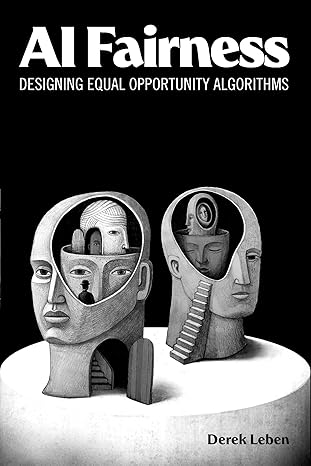
A theory of justice for AI models making decisions about employment, lending, education, criminal justice, and other important social goods.
This book draws on traditional philosophical theories of fairness to develop a framework for evaluating AI models, which can be called a theory of algorithmic justice - a theory inspired by the theory of justice developed by the American philosopher John Rawls.
About the Authors- Derek Leben is Associate Teaching Professor of Business Ethics at the Tepper School of Business at Carnegie Mellon University.
- Machine Learning
- Neural Networks and Deep Learning
- Artificial Intelligence
- Data Analysis and Data Mining

- AI Fairness: Designing Equal Opportunity Algorithms (Derek Leben)
- AI Fairness: from Principles to Practice (Arash Bateni, et al.)
-
 Fairness and Machine Learning: Limitations and Opportunities
This book is an introduction to the intellectual foundations of this recently emergent field, drawing on a diverse range of disciplinary perspectives to identify the opportunities and hazards of automated decision-making.
-
 Interpretable Machine Learning: Black Box Models Explainable
This book explains to you how to make (supervised) machine learning models interpretable. The book focuses on machine learning models for tabular data (also called relational or structured data) and less on computer vision and NLP tasks.
-
 An Introduction to Machine Learning Interpretability
Understanding and trusting models and their results is a hallmark of good science. Get an applied perspective on how this applies to machine learning, including fairness, accountability, transparency, and explainable AI.
-
 Machine Learning Engineering (Andriy Burkov)
The most complete applied AI book out there. It is filled with best practices and design patterns of building reliable machine learning solutions that scale. It embraces the most important thing you need to know about machine learning: mistakes are possible.
-
 The Hundred-Page Machine Learning Book (Andriy Burkov)
Everything you really need to know in Machine Learning in a hundred pages! This book provides a great practical guide to get started and execute on ML within a few days without necessarily knowing much about ML apriori.
-
 The Shallow and the Deep: Old School Machine Learning
This book is a collection of lecture notes that offers an accessible introduction to Neural Networks and machine learning in general. The focus lies on classical machine learning techniques, with a bias towards classification and regression.
-
 Distributional Reinforcement Learning (Marc G. Bellemare, et al)
Distributional reinforcement learning is a new mathematical formalism for thinking about decisions. This first comprehensive guide provides a new mathematical formalism for thinking about decisions from a probabilistic perspective.
-
 Hyperparameter Tuning for Machine Learning: A Practical Guide
This open access book provides a wealth of hands-on examples that illustrate how hyperparameter tuning can be applied in practice and gives deep insights into the working mechanisms of machine learning (ML) and deep learning (DL) methods.
-
 Approaching (Almost) Any Machine Learning Problem
This book is for people who have some theoretical knowledge of machine learning and deep learning and want to dive into applied machine learning. The book is best enjoyed with a cup of coffee and a laptop/workstation where you can code along.
-
 An Introduction to Quantum Machine Learning for Engineers
This book provides a self-contained introduction to Quantum Machine Learning for an audience of engineers with a background in probability and linear algebra, describes the necessary background, concepts, and tools, covers parametrized quantum circuits, etc.




