
|
FreeComputerBooks.com
Links to Free Computer, Mathematics, Technical eBooks all over the World
|
|

- Title: Introduction to Autonomous Robots: Mechanisms, Sensors, Actuators, and Algorithms
- Author(s) Nikolaus Correll, Bradley Hayes, Christoffer Heckman, and Alessandro Roncone
- Publisher: The MIT Press (December 20, 2022); eBook (Creative Commons Licensed)
- License(s): Creative Commons License (CC)
- Hardcover/Paperback: 288 pages
- eBook: PDF
- Language: English
- ISBN-10: 0262047551
- ISBN-13: 978-0262047555
- Share This:
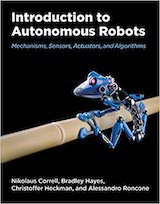
|
A textbooks that provide a broad algorithmic perspective on the mechanics and dynamics of robots, offers a much-needed resource for the computational fundamentals behind the design and control of autonomous robots. It covers principles of robot motion, forward and inverse kinematics of robotic arms and simple wheeled platforms, perception, error propagation, localization and simultaneous localization and mapping.
The authors use a class-tested and accessible approach to present progressive, step-by-step development concepts, alongside a wide range of real-world examples and fundamental concepts in mechanisms, sensing and actuation, computation, and uncertainty. Throughout, the authors balance the impact of hardware (mechanism, sensor, actuator) and software (algorithms) in teaching robot autonomy.
This book is open source, open to contributions, and released under a creative common license.
About the Authors- Nikolaus Correll is Associate Professor of Computer Science at the University of Colorado Boulder.
- Robotics and Robot Programming
- Machine Learning
- Artificial Intelligence
- Embedded Systems
- Neural Networks

- Introduction to Autonomous Robots: Mechanisms, Sensors, Actuators, and Algorithms
- The Mirror Site (2) - HTML and PDF
-
 Introduction To Autonomous Mobile Robots (Roland Siegwart, et al.)
This book discusses all facets of mobile robotics, including hardware design, wheel design, kinematics analysis, sensors and perception, localization, mapping, and robot control architectures.
-
 Artificial Intelligence, Data and Robotics (Edward Curry, et al.)
This open access book explores the rapidly evolving landscape of artificial intelligence, data and robotics (ADR), highlighting their foundational principles, transformative applications and future directions.
-
 AI Robotics: Algorithms and Technology of AI-Powered Robots
This open access book explores the intersection of robotics and physics and emphasizes the need for strict adherence to ethical principles in relation to overall progress and the development of humankind.
-
 A Mathematical Introduction to Robotic Manipulation
This book presents a mathematical formulation of the kinematics, dynamics, and control of robot manipulators. The foundation of the book is a derivation of robot kinematics using the product of the exponentials formula.
-
 Foundations of Robotics: Approach with Python and ROS
This book introduces key concepts in robotics in an easy to understand language using an engaging project-based approach. It covers contemporary topics in robotics, providing an accessible entry point to fundamentals in all the major domains.
-
 Modern Robotics: Mechanics, Planning, and Control
Offers a distinct and unified perspective of the mechanics, planning and control of robots. Ideal for self-learning, or for courses, as it assumes only freshman-level physics, ordinary differential equations, linear algebra and a little bit of computing background.
-
 Designing Interactions with Robots (Maria Luce Lupetti, et al)
Developing robots to interact with humans is a complex interdisciplinary effort. This fills an important resource gap in the human–robot interactions (HRI) community, and acts as a guide to navigating design-specific methods, tools, and techniques.
-
 Elements of Robotics (Mordechai Ben-Ari, et al)
This book bridges the gap between playing with robots in school and studying robotics to prepare for careers in industry and research. Robotic algorithms are presented formally, but using only mathematics known by high-school and first-year college students.
-
 Biologically Inspired Robotics (Yunhui Liu, et al.)
This book takes readers through an exploration of biologically inspired robot design and control, micro/nano bio-robotic systems, biological measurement and actuation, and applications of robotics technology to biological problems.
-
 Cognitive Robotics (Angelo Cangelosi, et al)
Covering the challenges of building AI-powered intelligent robots inspired by natural cognitive systems. offering the first comprehensive coverage of building robots inspired by natural cognitive systems.
-
 ROS Robot Programming (YoonSeok Pyo, et al.)
This book is a ROS robot programming guide based on the experiences accumulated from ROS projects like TurtleBot3, OpenCR and OpenManipulator. It's a comprehensive guide that covers all aspects necessary for a beginner in Robot Operating System (ROS).
-
 Modern Robotics with OpenCV (Widodo Budiharto)
This book is written to provide an introduction to intelligent robotics using OpenCV. It gives you a firm grounding in computer vision and OpenCV for building simple or sophisticated Robotics applications.
-
 Robotics for Beginners (Tejinder Devgon, et al.)
Provides a thorough foundation around robotics, this book takes you through a lot of essential topics about robotics, including robotic sensing, actuation, programming, motion control, and kinematic analysis of robotic manipulators.




